
Name-Based Case Searches
Cedar runs no docket database of its own. The statewide public route is JUSTICE Case Search, including the Nebraska.gov One-Time Court Case Search. Enter the party's legal name, never a witness name. Older official guidance says a last name alone works, and a fuller entry follows Last Name, First Name, M, Suffix. One wrong middle initial can return nothing at all.
- Gather the party's exact legal name or, preferably, the case number from a notice, citation, order, or clerk communication.
- Open the one-time search, accept its terms, and enter the party name. Use a last-name-only search first if a complete entry fails.
- Select Cedar County and choose County Court or District Court when the form presents that option. Add year, case type, subtype, judge, or attorney only when known.
- Review the party name and type, case number, caption, judge, attorney, and Details link. Do not assume the first matching name is the correct matter.
- Open Details on the correct case and inspect the case summary, parties, register of actions, available images, and settings before drawing a conclusion.
Cedar County splits its court records between two clerks. County Court handles traffic tickets, misdemeanors, city ordinance cases, small claims, probate, guardianship, adoption, juvenile matters, and felony preliminary hearings. District Court takes over from there. It holds district felony records after bind-over, plus larger civil and domestic cases, protection orders, and other district filings.
Unsure which court holds the docket you need? Call first. County Court Clerk Magistrate Diane Sudbeck is at 402-254-7441, and District Clerk Janet Wiechelman is at 402-254-6957. A quick call beats a wasted docket search in the wrong court.
Cedar JUSTICE Search Filters
The official JUSTICE search demo reveals far more filters than a plain name box. Party Name is the core field. Party Type separates an individual from an entity. Pick Cedar under County. Use Court Type to limit the lookup to County Court or District Court. Case type and subtype, year, judge, attorney, sort, and sort order all help when one name pulls too many results. Client Memo appears there for invoice or payment use, not as a case-search criterion.
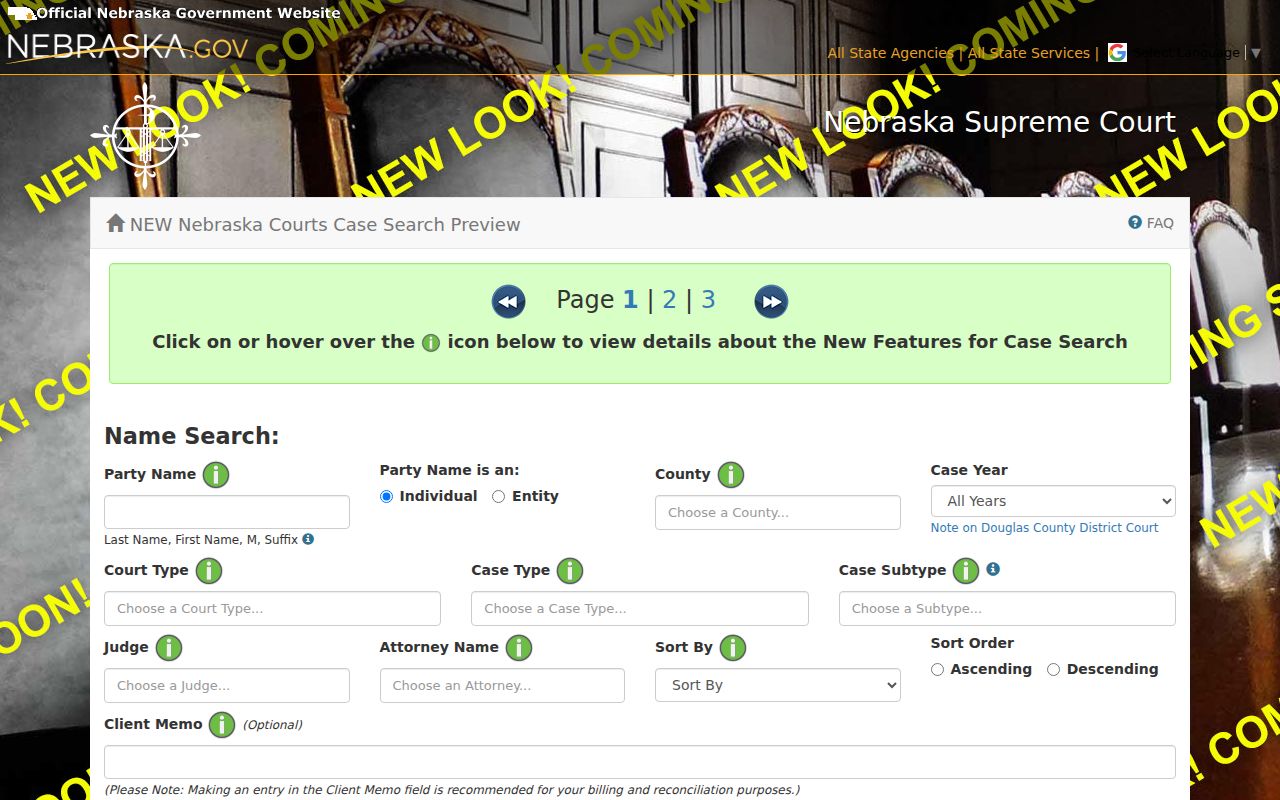
Refine only with facts you know belong to the case. Choosing Cedar and the right court type cuts out unrelated statewide matches. But a wrong year, subtype, judge, or middle initial can bury the correct record.
| Field | Type | Use in a Cedar search | Notes |
|---|---|---|---|
| Party Name | Text | Primary search anchor | Last name alone may work; a complete name follows Last, First, M, Suffix. |
| County and Court | Selectors | Narrow to Cedar and the right trial court | Choose County Court or District Court when known. |
| Year and case type | Select or typeahead | Reduce common-name results | Use only a supported year, category, or subtype. |
| Judge or Attorney | Typeahead | Additional refinement | Neither substitutes for verifying the party and case number. |
Case Number Searches
Nothing anchors a lookup like a complete case number. The official demonstrations use formats such as CI 00 0000000 and C 02 CI 09 0016975. Letters, court or case-type elements can appear in the display. A year and a sequence can appear too. These are examples of the official interface, not a Cedar code key. Without clerk confirmation, never decode a local court or case status from a digit or prefix. Type the full number exactly as it appears on the citation, notice, register, or court paper. Then compare the returned caption, court, and parties against the source document. A case can move from County Court to District Court. That happens after a felony preliminary hearing and bind-over. It may also pick up an appellate number later. So separate numbers do not, by themselves, mark a result as wrong.
Cedar Common-Name Result Limit
The one-time route costs $17. It permits up to 30 records and stays open for three calendar days. Expect the charge even when nothing comes back. If a broad name search hits the limit, resist grabbing a record at random. Add Cedar, the correct court, a year, a case type or subtype, judge, or attorney. Then run it again. Under the current terms, a search must be modified. It must return no more than 30 records.
Current access choices: One-time search is the short-term route for up to 30 records. A Nebraska.gov subscriber account is $100 annually, permits general list searches without a separate search charge, and charges $2 for case detail, judgment-date, or court-case-number searches. Available document images have no additional charge after that detail access.
Older JUSTICE help material still cites a $15 one-time price and older detail pricing. The current portal terms, eServices information, and 2025 fee announcement back the $17 and $2 figures. That gap is exactly why you should check the portal price before paying.
Case Search Results Explained
A JUSTICE result row typically lists the party name and type, case number, caption, judge, attorney, and a Details link. The details screen holds the case-level record. Depending on the matter and public-access rules, it may include a case summary, parties and attorneys, criminal offense information, judgment and financial panels, a register of actions, judge notes, and links to nonconfidential images.
| Case summary | Header information such as court, county, case ID, caption, classification, filed date, closed date, and disposition when maintained. |
|---|---|
| Parties and attorneys | Public party roles, status, attorney information, and aliases where maintained and public. |
| Register of actions | The chronological index of filings, hearings, notices, orders, service, and other recorded events. |
| Financial and judgment panels | Public costs, payments, judgment information, and later satisfaction or enforcement entries where applicable. |
| Images | Clickable images of nonconfidential filings when available. A visible register entry does not guarantee an image. |
Work through the register in date order. That way an initiating filing stays distinct from a later order, notice of setting, disposition, payment, or appeal. Remember, the register indexes case events. It is not always the filed document itself.
Details, Registers, and Images
The official JUSTICE results demonstration shows the result list leading to Details rather than laying out the whole case on one line. Open a matching matter only after checking the displayed name, number, caption, judge, and attorney against what you already know. That extra step pays off when several Cedar or statewide cases share one party name.
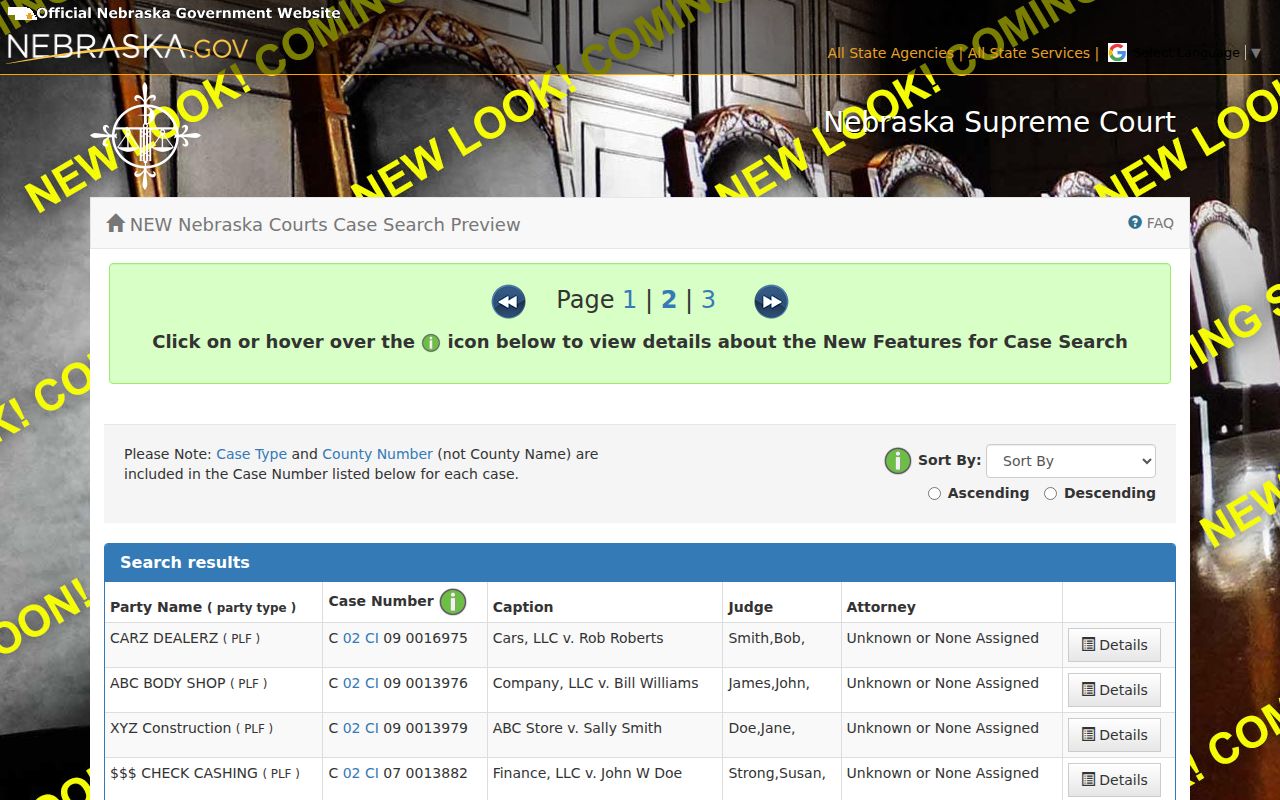
From Details, let the register pinpoint the event and date that matter. Public document images may be linked there, especially for nonconfidential filings, though availability turns on the case and the document. When an image is missing, ask the right Cedar clerk for that particular document instead of assuming it was never filed.
Two Ways to Search: County and State
Cedar County does not run its own docket site. Your online option is the statewide JUSTICE system, where Cedar is simply a filter you pick, along with a court type such as County Court or District Court. The other path runs through the courthouse itself. A free public terminal, the right clerk counter, a phone call, mail, or a copy request all work there. Both routes rely on the same public-access model. Just note that a remote search fee does not tell you what the courthouse terminal costs, since the terminal itself is free to use.
| Route | Best use | What it provides | When to move on |
|---|---|---|---|
| JUSTICE remote search | Finding a public case by name or known number | Statewide scope, Cedar filtering, public details, and available images | Refine filters, allow for lag, or contact the clerk when the answer is uncertain. |
| Cedar courthouse terminal or counter | Free public access, direct routing, and older-record questions | JUSTICE public terminal and clerk assistance during office hours | Use a formal copy or records request for a specific document or broader custodial search. |
Mail still works for a Cedar County court records request. Send it to County Court, PO Box 695, Hartington, NE 68739, or to the District Clerk, PO Box 796, Hartington, NE 68739. Both offices publish a shared fax line at 402-254-7447. District Court also lists an email address, districtcourtclk@cedarcountyne.gov. Need something formal? A court-record request under CC 3:29 should name the case and the document you want, while a broader public-records request falls under Nebraska Revised Statute §84-712.
Cedar's 24-Hour Search Lag
JUSTICE runs on a delay. A new docket entry can take about 24 hours to show up. Older official guidance allows up to a week for some information. When a Cedar County case goes missing, fix the spelling and middle initial first. Then drop extra filters and try the other Cedar court. Give the system its documented lag before concluding the record is not there. The calendar carries its own delay warning, so confirm any future hearing date with the clerk. Older records hit a coverage wall, too. Cedar District Court came online in November 1999. Criminal and traffic records followed in June 2000. Probate, adoption, civil, and small claims came in November 2000, and juvenile in January 2004. Anything filed before those dates may live on paper or microfilm. So ask the clerk about retention or submit a formal request. One caution on eFiling: Nebraska's attorney eFiling system handles filings and service. It is not a public stand-in for a JUSTICE case lookup.
Which Cases Stay Restricted
Access rules start open. Nebraska Supreme Court rule §1-805 makes listed categories public unless law, court rule, or policy restricts them. Public information can include the case summary, parties, register of actions, available images, calendars, and summary judgment data. Rule §2-215 takes the same approach for electronic filings. Still, seeing an event on the docket does not guarantee the filing image behind it is public. Juvenile cases in Cedar County are County Court matters. Yet those records get confidentiality and sealing treatment under Neb. Rev. Stat. §43-2,108.05. For adults, §29-3523 governs removal of qualifying criminal records. It takes a required process or order. A blank result can mean sealing, juvenile treatment, a typo, a lag, or a record older than the electronic system. Do not press court staff to reveal restricted content. The better question is which law, rule, or order controls access.
The Cedar Courthouse Kiosk
Some Cedar County cases simply do not resolve from a keyboard. Nebraska puts a public JUSTICE terminal inside the courthouse, available during regular office hours. That terminal is the dependable fallback when a docket search online stalls. Ask at the counter for access. The county posts no kiosk number or printing guide. Both the County Court and the District Court keep weekday hours of 8:00 a.m. to 5:00 p.m., and they stay open through lunch.
You can still run a one-time search entry from home. It is a state page where a party name starts a live docket lookup. A courthouse visit beats guessing when that query fails. Bring the case number or party name. Name the right court. Then let the clerk point you to the correct route for an old record, a copy, or a restricted file. If staff require a written request, §84-712 applies. The office must respond as soon as practicable and no later than four business days after actual receipt. The statute also sets rules for estimates, denials, and difficult requests.
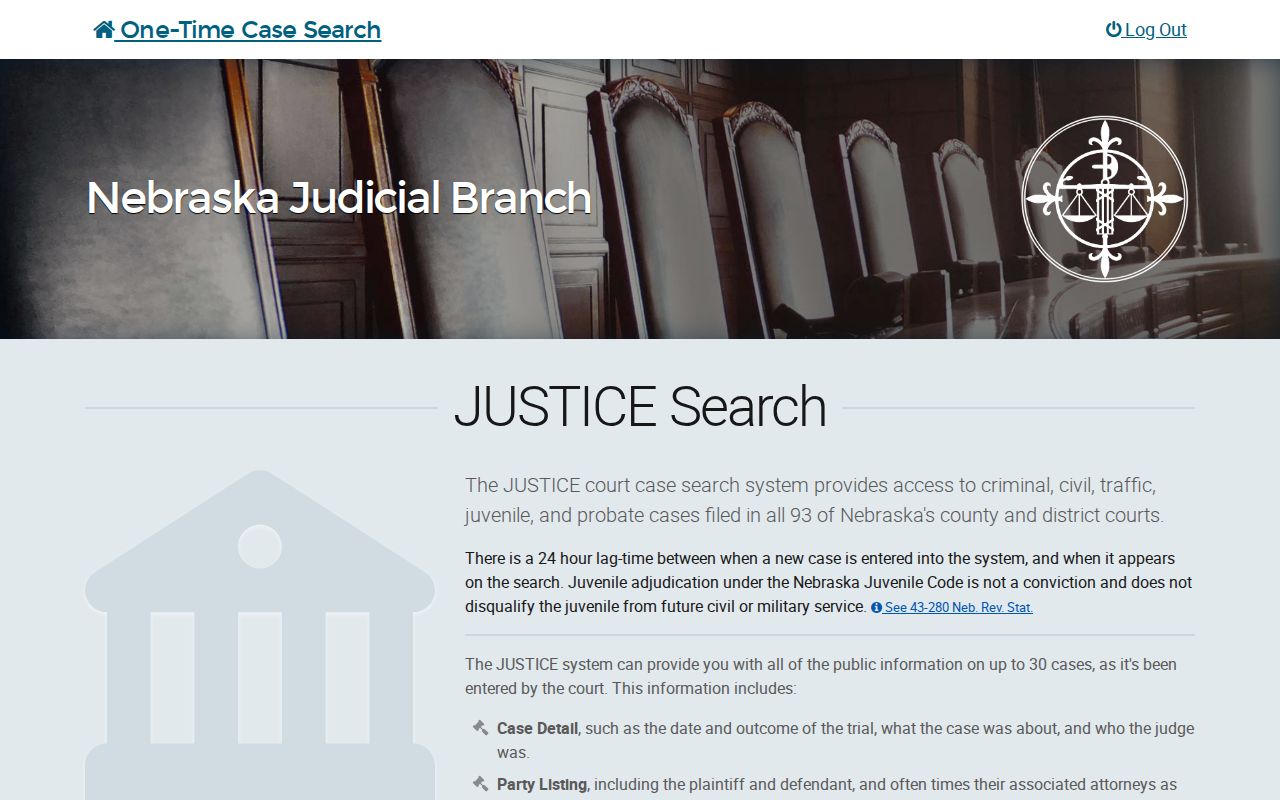
The entry screen is the remote starting point for a paid one-time search. It does not replace the local counter, a mailed request, or a formal access route when one of those is the better way to reach a Cedar County court record.